
The campaign we almost killed
On paper, it was losing money. It was actually the company's best campaign.
Forwarded this? Subscribe here. · Share this issue
Howdy, David here (John’s son, if we haven’t met)! We’ve got a story for you this week.

A few years back, I almost talked a client into one of the most expensive mistakes they could have made. And everyone, including the client, was all for it.
The only reason it didn’t happen was one last number I decided to check.
Heads up: there’s a quick poll and an ask from John and me down below. We’d love your help with both.
A one-and-done business
Here’s the quick context you need to know.
The client was a big industrial flooring company. Think of the folks who put down the floors in huge Walmarts and warehouses all across the United States. They had long touted that almost all of their customers were one-and-dones: see a customer once, do the flooring work, leave, and never come back.
One of the services they provided was line striping. It’s OSHA-required: those big, long yellow markings you see in warehouses that keep people safe and out of places they shouldn’t walk. It’s generally a small job, a couple thousand dollars on average.
For years, we’d been running an amazing Google advertising campaign for it. We were some of the first to figure out how to advertise it well, and we found keywords no one else was using.
But those glory days didn’t last. Competitors caught on and copied us. Ad prices climbed, and our return slid toward break-even. Not a place you want to be in advertising.
So after a few meetings, John and I did the responsible thing and recommended killing the entire campaign. Everyone was super supportive.
The twist
Sometimes the good Lord uses things in unexpected ways.
At the same time, we were running a data science project to answer a question this company had never actually checked: do customers really never come back?
In other words, what’s the lifetime value of a customer? Not one big old average that says the typical customer is worth X dollars, but what a customer is worth when a particular service is the first job we do for them.
And something very peculiar showed up when we looked at line striping.
Customers whose first job was line striping were worth far more than that little job suggested. More often than not, they came back within two years for a second project, and the second one was usually much bigger. Floor repairs. Brand-new floors. Some of them became two-, three-, four-time customers.
If that was true, the campaign we were about to kill wasn’t near break-even. Counted at what those customers were actually worth, it was returning closer to ten-to-one.
Calling off Order 66
So we called off Order 66 and went looking for proof outside the spreadsheet. Within a few weeks, we had it.
Line striping was cheap and easy to say yes to. The customer was required by law to have it done. But it got the company’s crew inside the building, looking at the floors and finding all the other problems that really should be fixed. Their savvy sales guys turned that into second, third and fourth jobs.
The “one-and-done” company had a door opener and didn’t know it.
A year later, we reran the numbers to check ourselves. We were right, and then some: it came out closer to 20-to-1.
The scary part isn’t that the campaign looked bad. It’s that every number we were looking at was correct. We were just counting the first sale and calling it the whole customer.
⚾ Your At-Bat
Here’s the question to take with you this week:
What’s something everyone in your company “knows” that nobody has actually checked?
For our flooring client, it was “we’re a one-and-done business.” Decades of company culture said so. If we hadn’t challenged it, we’d never have found out that, more often than not, line striping customers came back for a second job, and that their lifetime value meant we should be spending more on that campaign, not less.
The hard part is never asking the question. It’s knowing which number to look at: the one that cuts past how everyone feels and gets straight to the facts.
That’s exactly what Billy Beane did to baseball. The scouts “knew” what a good player looked like, and the numbers said otherwise.
📰 Around the Horn
New article: LTV Is All You Need. How to calculate it, how to avoid the mistakes other businesses make, and why it’s the #1 metric we use when looking for bottlenecks in a company. Read it here.
We made baseball cards? We’re starting to do a lot of writing, and part of that is getting real human experts to read what we wrote, so our readers know we’re not putting out “AI slop.” So to say thank you, we turned all of them into baseball cards.
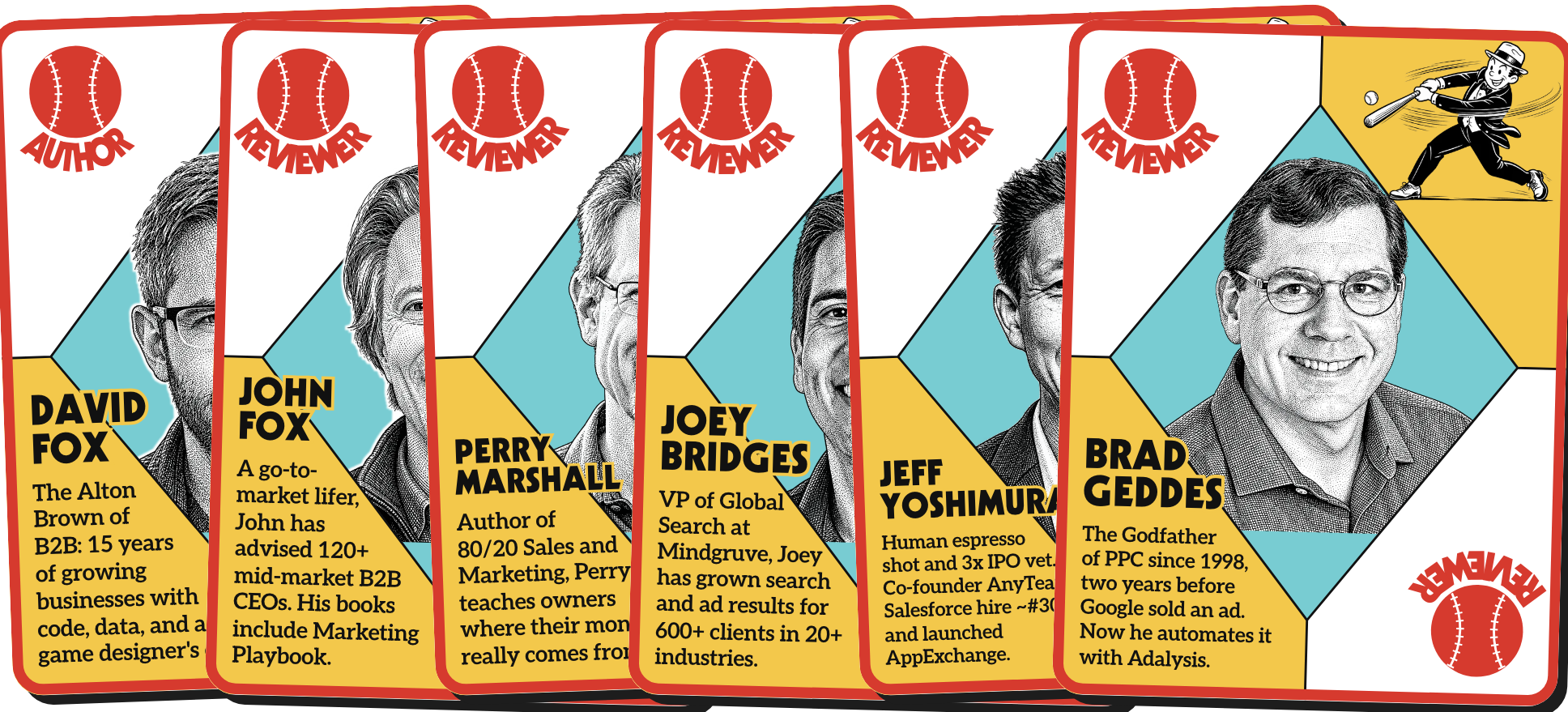
If you know someone who ought to review an article like this one, or if that’s you, please let us know. An intro would be wonderful!
🍿 Comic Relief
Something to get you through the week.
A new sales VP walks into the building and holds a meeting. First thing on the agenda? Cleaning up that darn ol’ CRM everyone keeps complaining about. Should be simple… right? Watch what happens (2 min).
Time to play ball!
David Fox
Co-Founder, Moneyball.win
david@moneyball.win
linkedin.com/in/foxdavidj/