
The Moneyball Gazette The Blog
The Original Hunch Behind Moneyball
A simple question, a statistical rebellion, and the deeply suspicious idea that sales software does not have to be boring.
By The Moneyball Desk

Moneyball started with a simple question and a challenge.
What would happen if every sales team had access to the kind of intelligence usually reserved for the biggest companies, the fanciest suits, and the people who can afford to ask McKinsey for a second opinion?
And what if that intelligence did not live in another boring dashboard for upper management to admire from a safe distance?
What if it made its way to the people actually making the sales?
What if it was useful, clear, and fun enough that reps actually wanted to use it?
That was the bet.
Section I
The Original Hunch
The idea that inspired Moneyball is not subtle. It is right there in the name.
Baseball changed when people stopped asking who looked like a great player and started asking which numbers actually helped teams win.
Sales has its own version of that problem.
A lot of teams are still running on averages, vibes, scattered reports, and the occasional heroic spreadsheet. Meanwhile, the best insights often live behind enterprise software, expensive consulting, or a data scientist who is currently trapped in a meeting about field definitions.
We thought that was odd.
So we started building Moneyball.win, a way to help sales teams see which accounts deserve attention, which patterns are hiding in the data, and where the next smart move might be.
Section II
Why We Made It Free
If better sales intelligence only belongs to the teams with the biggest budgets, nothing really changes.
We want to see what happens when the playing field gets leveled.
- What if every sales team could see better signals?
- What if reps had clearer reasons to reach out, follow up, or focus somewhere else?
- What if success came down a little less to who bought the fanciest tool, and a little more to who understands their customers, has better conversations, and actually sells something worth buying?
That seems like a more interesting world.
So Moneyball is free.
We may offer advanced tools or special programs around it. But the machine itself is meant to be available to the teams who need it.
Section III
The Team Behind Moneyball
Moneyball is built by people with strong opinions about sales, design, data, software, and fun.
The short version:
- David built the machine.
- John knows the sales world it is trying to help.
- Mr. T helped provide the wisdom behind it.
David is the principal engineer behind Moneyball. He built the product, shaped the experience, and keeps asking the question that tends to make software better: “Could this be simpler, clearer, and more fun to use?”
He is a self-taught engineer, designer, and data analyst. He has contributed to Google Chrome, helped lead the Google Web Almanac, and worked with enormous sets of web data at a scale where most spreadsheets would quietly excuse themselves.
But his real obsession is not data for data’s sake. It is making complex information feel instantly understandable, useful, and even a little delightful.
John has spent decades in the world Moneyball is trying to help: sales, marketing, business development, go-to-market strategy, customer empathy, and the practical work of helping companies grow.
He knows why good strategies die in the field. He knows why CRM data gets messy. He knows why technically correct advice often fails when it meets real people, real accounts, real incentives, and real calendars.
At Moneyball, John brings the operator’s eye: what revenue teams actually need, what reps will actually use, and what kind of signal helps a sales manager have a better conversation before the quarter gets away from them.
Section IV
We Care About Taste
We believe useful software should also have taste.
That does not mean decoration for decoration’s sake. It means the product should respect the person using it. It should be clear. It should have rhythm. It should make the right next move feel obvious.
A lot of sales software feels like it was designed by a committee, approved by procurement, and then punished for having a personality.
We are trying not to do that.
Moneyball is meant to feel like a game in the best sense: clear rules, visible progress, useful feedback, and the occasional little grin when the machine does something helpful.
The jokes are not there to distract from the work. They are there because people do better work when the tool in front of them does not make them feel dead inside.
Section V
What We Are Building Toward
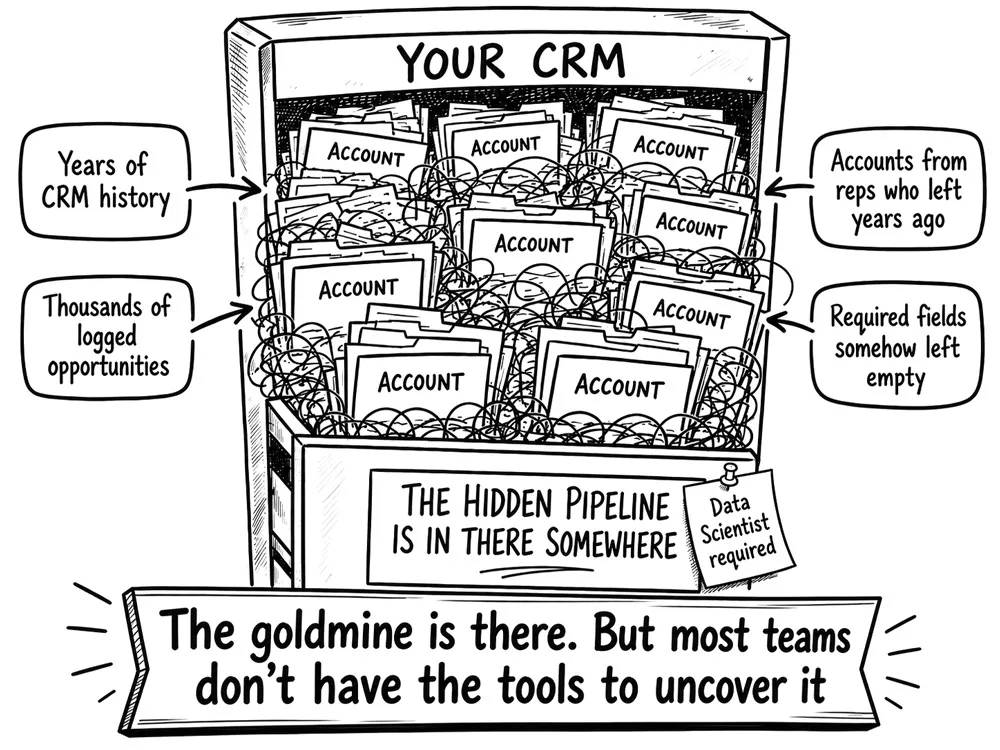
The first version of Moneyball is focused on helping teams find hidden pipeline in the CRM they already have.
That means second-sale candidates. Win-back opportunities. Cross-sell openings. Seasonal buyers coming back into season. Expansion and retention opportunities that should not require a heroic spreadsheet expedition to notice.
But the larger idea is broader than that.
We want sales teams to get sharper without needing a giant analytics department. We want reps to understand their books of business better. We want managers to coach from evidence instead of panic. We want good operators to see the game more clearly.
And if we can make the whole thing feel a little less like software and a little more like discovering a useful secret compartment in the board game box, well.
Splendid.